
Washington, DC · Online · Ages 14–18
Think for yourself.
Think of others.
Belong as you are.
An online upper secondary school for teens who question, create and organize, whether they’re homeschooled or coming from a public, private or charter school. Study on your own time, learn live with real educators and build community with peers who want to change the world.
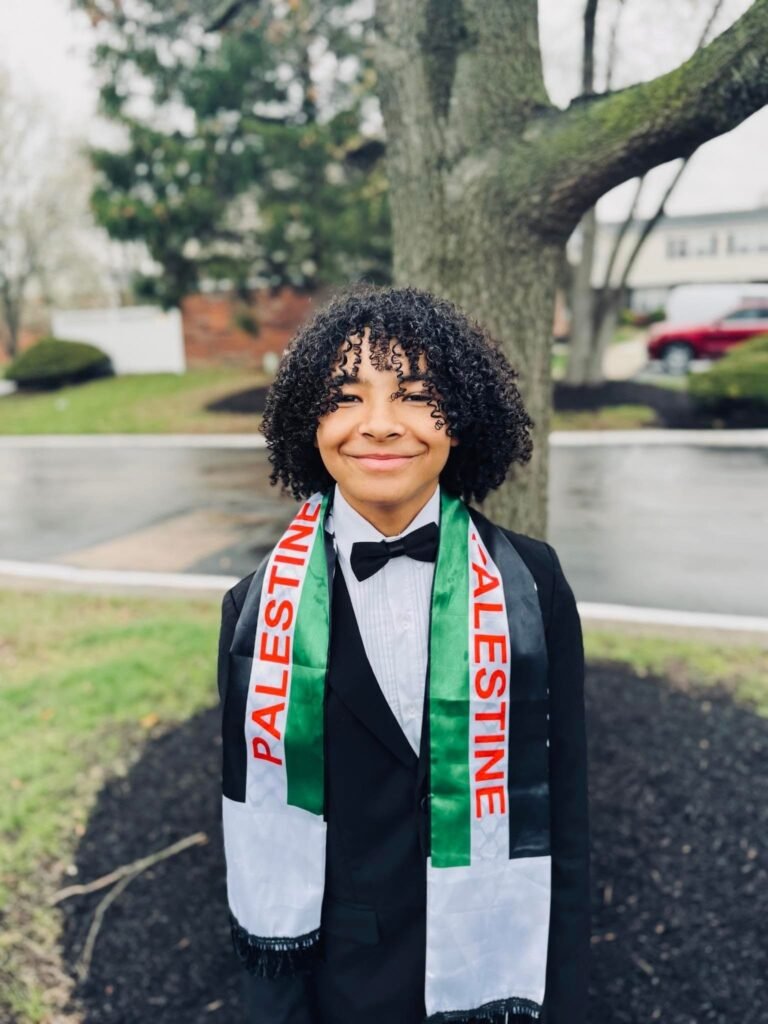
For freethinkers, artists, organizers and the next generation of changemakers.
An education for those who question the status quo.
01
Education should do more than prepare students for exams. It should cultivate independent thought, welcome difficult questions and inspire young people to imagine a world beyond the one they inherited.
We make room for the outspoken and the unconventional: the artists, activists, questioners and builders. Students gain the confidence to form their own opinions and the courage to challenge established ideas, question existing systems and imagine new possibilities.
Community shouldn’t require conformity. Students here disagree without becoming divided, find their people without losing their perspective, and think for themselves without thinking only of themselves.
Thought is independent. Progress is collective.
Will my child get a complete high school education?
02
Yes. Abule is a four-year upper secondary school for First through Fourth Year students, with English, math, science, social studies, world languages, the arts and electives. Abule partners with an accredited, state-recognized U.S. private high school, so Accredited Diploma students earn a high school diploma from Abule along with an official accredited transcript. A lighter Certificate of Completion path is also available.
| Subject | Accredited Diploma (24 credits) | Certificate of Completion (18 credits) |
|---|---|---|
| English | 4.0: English I, English II, Literature Studies, Literature & Composition | 4.0, same courses |
| Mathematics | 3.0: Algebra I, Geometry, Algebra II | 2.0 at Algebra I or above |
| Science | 3.0, at least 2 with lab, including Biology I | 2.0 |
| Social studies | 4.0: World History, U.S. History, Law & U.S. Government, plus Africana Studies or Geography | 3.0 |
| World language | 2 years of the same language | Not required |
| Arts | 1.0: Art History, Broadcast Journalism or an approved outside course | 1.0, same choices |
| Physical education | 1.0 (logged) | Not required |
| Health | 0.5 | Not required |
| Electives | 5.5, including the Fourth Year Capstone | 6.0 |
| Total | 24.0 | 18.0 |
Four years, step by step
- English: English I, then English II, Literature Studies, and Literature & Composition in Fourth Year.
- Math: Algebra I, Geometry and Algebra II, starting at the right level after a short placement test.
- Science: at least three credits, two with lab, including Biology I.
- Social studies: World History, U.S. History, Law & U.S. Government, and Africana Studies or Geography.
- Fourth Year: a Capstone project, college and career planning, and graduation at the end of February.
A few of our courses
- English I: Voice, Identity and Power
- Literature Studies: Literatures of Resistance
- Africana Studies
- Law & U.S. Government
- Earth Science with Lab and Environmental Science with Lab
- Introduction to Broadcast Journalism, French I and Swahili I
Where it leads
Students finish with a transcript of their courses and credits, a portfolio of real work, a Capstone project and a plan of their own, whether that’s a university, a skilled trade, a creative career or community work. College and career counseling starts well before Fourth Year applications in the fall.
Learn on your own time. Never on your own.
03
The freedom of homeschooling, with the educators, structure and community of a real school.
01
On your schedule
Coursework moves at each student’s pace within weekly deadlines. Fridays have no live sessions.
02
With live educators
Small live sessions Monday through Thursday: lectures, class discussions, labs and workshops, with personal feedback.
03
Among real peers
Classmates nationwide, Student Council, student-led clubs and in-person meetups in Washington, DC. Adults moderate every community space. How we keep students safe.
Who thrives at Abule
04
Independence is at the heart of Abule, and it asks a lot of students. They don’t have to manage everything alone, but they do need to be willing to show up, take part and do the work between live sessions.
A strong fit for students who
- Question the status quo and ask why
- Love to learn and manage their own time
- Want to debate ideas with educators and peers
- Care about their community and want to act on it
- Are willing to take part, even if staying organized is still a work in progress
Likely not the right fit if a student
- Isn’t willing to work independently between live sessions
- Needs school staff to manage their work day to day
- Prefers not to take part in live sessions
Learning differently? You’re welcome here. Students with ADHD or executive-function challenges, and students coming from a hard school experience, are welcome at Abule. Independent work is a real part of the model, so here is the support we offer: educators check in with students, live sessions give each week a steady structure, every student has a weekly schedule of live sessions and deadlines, and ILP mentors guide each student’s Independent Learning Project. The Learning support section of the application is where you can tell us how your student learns best. We can’t promise daily reminders, so families usually help with planning at home. Not sure? Book a call and we’ll talk it through.
Think and do
05
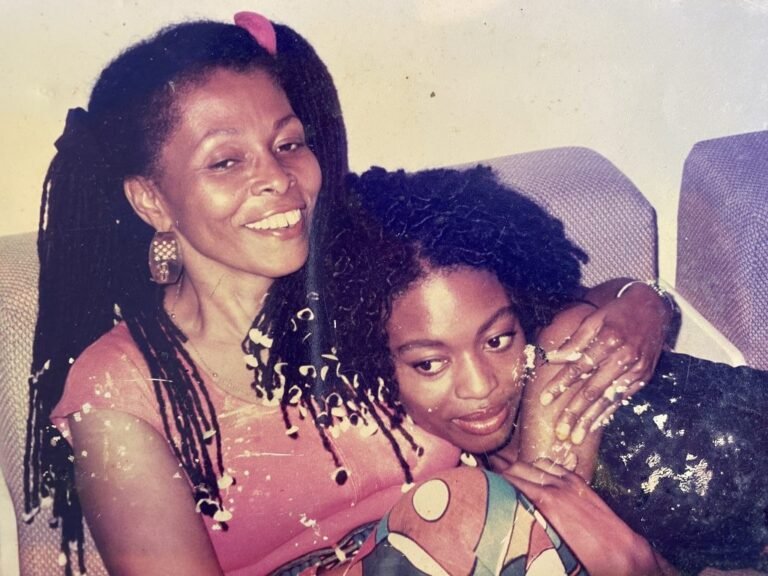
“Before going back to college, I knew I didn’t want to be an intellectual, spending my life in books and libraries without knowing what the hell is going on in the streets. Theory without practice is just as incomplete as practice without theory. The two have to go together.”
Assata Shakur, Assata: An AutobiographyWe want students who think and do. Study informs the work, and the work sharpens the study.
20
Hours of service a year
Documented community service with causes each student chooses.
1
Independent Learning Project
Each year, students document an overlooked history, organize an initiative, research an issue or create something original.
Activism is one expression of that learning, not the only one. Research, art, innovation and thoughtful leadership matter just as much.
A week at Abule
06
Live sessions run Monday through Thursday. The rest of the week belongs to the student.
- Live sessions
- Monday–Thursday, between – ET
- Fridays
- No live sessions
- English, math and science
- Meet twice a week
- Social studies and electives
- Meet once a week
How much work is it? A full load is about six courses. Most students have roughly 8 to 11 live sessions a week, about 7 to 9 hours live. Each 1.0-credit course is about 120 hours of work over the year, so a full load comes to about 20 hours a week in total, Monday to Friday. Between live sessions, students watch short lessons, read, practice, write and work on projects on their own schedule, within weekly deadlines. Parents don’t need to teach: they help their student keep a steady routine, check in on weekly deadlines and sign the physical education log.
See the work
07
Real courses and real assignments. Here is a look inside.
Inside Africana Studies
Clips from live sessions, from a lecture on Reconstruction to an Underground Railroad escape room, plus the assignments behind them. Go inside the course.
What students make
In English I, students finish with a Voice portfolio and a recorded speech. Law & U.S. Government ends with a mock trial. Geometry students redesign a real street at scale, and Swahili I students finish with a short podcast in Swahili. See every course.
A project of their own
Every year, each student completes an Independent Learning Project on a question they choose, with a mentor, and presents it at the public year-end showcase. In Fourth Year it becomes the Capstone.
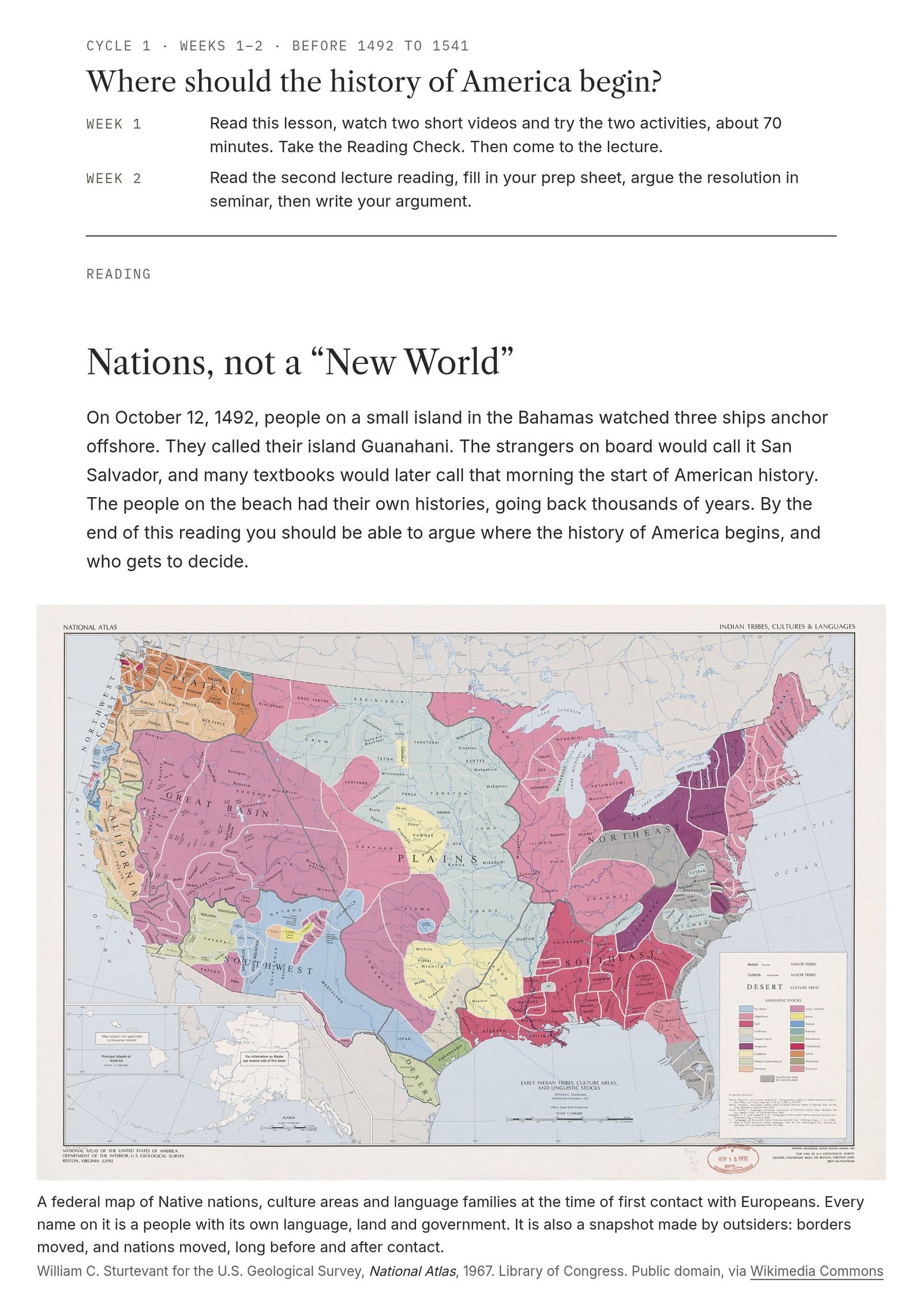
Inside a lesson
This is the Week 1 reading from U.S. History, Cycle 1: Indigenous America. Students read it and work with maps and primary sources on their own time, then bring their thinking to the lecture. The Cycle ends with a seminar and an argument essay.
Course syllabi
One-page syllabi for some of our 2027–28 courses:
Completed student work
A student-designed issue of a Black Panther Party newspaper, an admissions brochure for an HBCU, and one student’s attempt at a real 1964 Louisiana voter literacy test. See the work.
Students who lead
Meet a Student Ambassador, and see how Student Council and student-led clubs work. Explore student life.
An example week
See a First Year student’s week of live sessions and own time, in your time zone. See the example week.
What parents say
“Thank you again for offering this to our learners. My student is engaged and motivated.”
Georgette B., Parent
“THIS IS AMAZING!! Thank you so much for offering this opportunity to my student!”
Lorraine Q., Parent
“Thank you for all that you are doing and for being a lovely person.”
Christine G., Parent, writing to an Abule educator
“Thank you so much for all of your hard work and dedication to your students!”
Sam M., Parent
Our educators
08
Our educators teach live from around the world, and each course has a dedicated educator who leads its live sessions and gives feedback on student work.
Here are a few of our international educators.
How we choose our educators. Every educator is personally interviewed before being hired, has their degrees and certificates verified, and is background-checked before working with students.
Records and progress. Families receive progress summaries and report cards, and Abule keeps student records and handles transcript requests. Request a transcript.
A future of their own
09
Academic guidance, college and career counseling, and mentors from many backgrounds. We don’t prescribe a future; we help each student choose one of their own. Accredited Diploma students earn a high school diploma from Abule along with an official accredited transcript.
- Universities
- Skilled trades
- Entrepreneurship
- Creative professions
- Community organizing and public service
- Paths not yet imagined
Within reach, on purpose
10
A transformative education shouldn’t depend on what a family can afford. As a program of Floating Freedom Foundation, a 501(c)(3) nonprofit, we keep tuition well below many private online schools.
Annual
Lowest total
$2,800 a year
One payment for the full 2027–28 school year.
Quarterly
4 payments
$750 × 4
$3,000 a year, paid every three months.
Monthly
12 payments
$275 × 12
$3,300 a year, paid each month.
- ESA funds
- Accepted via ClassWallet
- Application fee
- None
- Registration fee
- None
Spring 2027
11
- Classes begin
- Monday, March 1, 2027
- Priority deadline
- January 1
- Decision by
- Jan 30
- Limited seats
- Waitlist when full
Abule is intentionally small, so every student is known by name and places are limited.
Not ready to apply?
12
That’s fine. Book a call to talk it through, or send us a question and get occasional updates about Spring 2027.
Send us a question
Common questions
13
Is Abule self-paced or live?
Both. Students complete coursework on their own schedule within weekly deadlines, then meet live with their educator and classmates for discussion and feedback.
Is Abule right for a student who doesn’t want to do schoolwork?
Usually not. Much of the week is self-directed, so Abule works best for students who are willing to take part and do the work between live sessions. They don’t have to manage everything alone: educators check in, live sessions give each week structure, and families help keep a steady routine at home.
Does my student need to write an essay to apply?
No. Students can respond in writing, audio, video, artwork or a conversation with our team. There is no application fee.
Our principle
Community without conformity.
Unity without uniformity.
Not just to inherit the world, but to imagine what comes next. Questions first? Email info@abule.education, call +1 (202) 330-8919, or book a call.
Prefer to talk first? Book a 30-minute video or phone call.
 Google